Someone once said: “if mountaineers had memories, the mountains would never be climbed.” Now, while the memories of K2 are still fresh, I think much the same. It would be very difficult for me to set off for the mountain again, because there were simply too many hard moments.
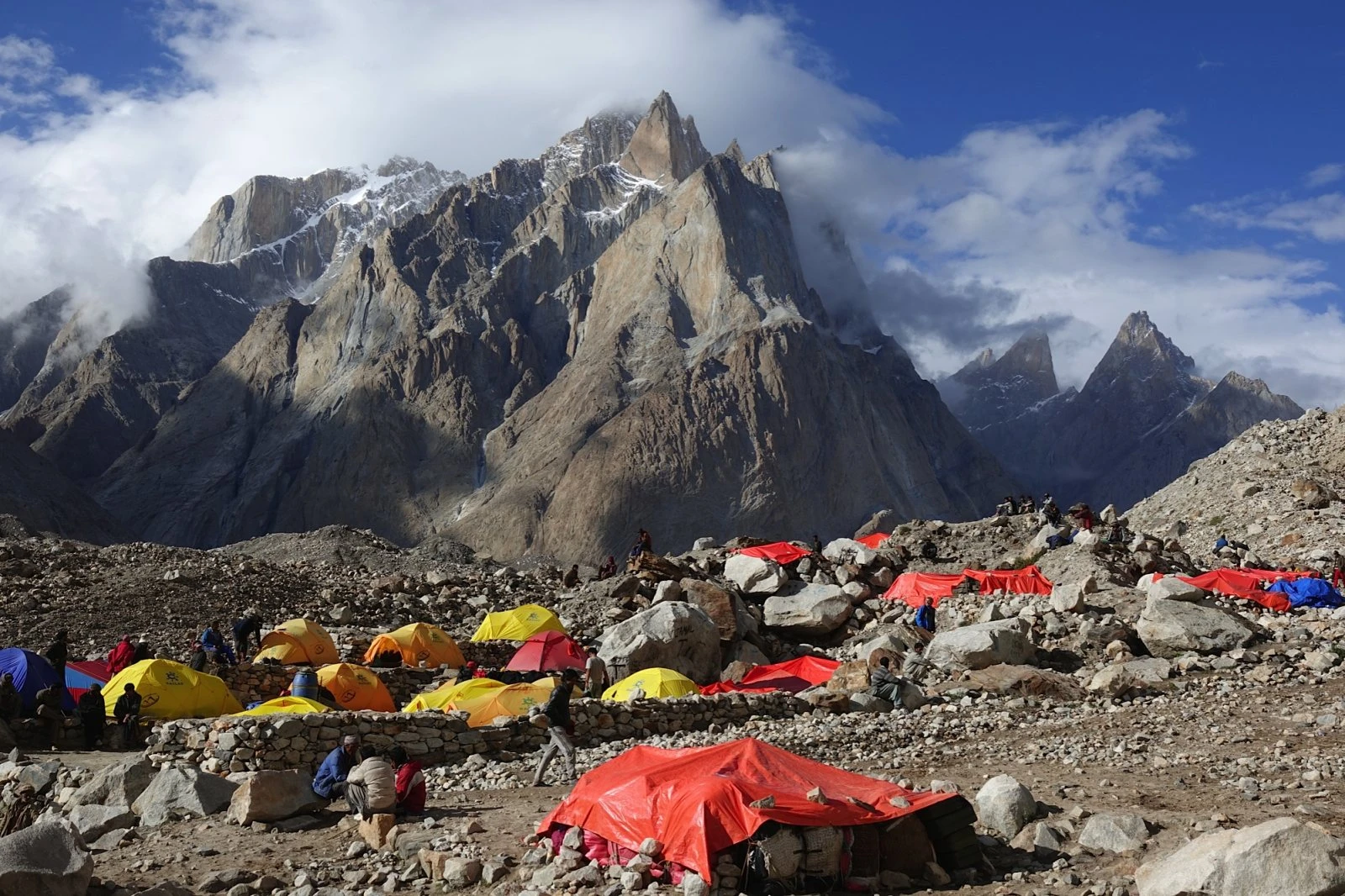
I left home on 15 June from Ljubljana Airport, travelling via Istanbul to Islamabad. After two days in the capital of Islam, a local Airbus dropped us in Skardu, the capital of Baltistan, a place even Alexander the Great managed to reach. Unfortunately, the area lies under the dark wing of the Pakistani army, since it borders Indian Kashmir, which Pakistanis consider theirs. We covered the road to the easternmost village of Askole, a road that rivals the notorious Karakoram Highway in terms of adventure, in forty-year-old Toyotas; from there we continued on foot. We were accompanied by a group of trekkers, 240 porters and five young bulls, which we ate during the ten-day journey to Concordia, where the weather occasionally spoiled the magnificent view of the eight-thousanders. Nevertheless, the confluence of the largest glaciers in the world is well worth seeing. After a day of rest we set off in heavy snowfall toward base camp, which we established somewhere between the classic camp for climbing Broad Peak and the K2 base camp. We pitched our tents on half a metre of fresh snow between two glacial streams, while the roar of avalanches from the slopes of both giants made us realise that they were very close, even though poor weather prevented us from seeing them at all for several days. A somewhat depressed group of Japanese and Canadians had already been bored at base camp for ten days before our arrival, so they were even more delighted by the sun that timidly warmed our home.
The view of K2 from the glacier providing access from the Pakistani side is breathtaking and frightening and, in the same heavy breath, a privilege that, unlike Everest, cannot be reached by car but only after a demanding trek to base camp. The almost perfectly shaped, three-kilometre-high pyramid rises to 8,611 metres and only occasionally shows its shy face from behind icy clouds. The weather is extremely changeable and is one of the key factors that make climbing the mountain so difficult. Mornings were usually beautiful, almost warm; around eight o’clock the sun appeared from behind the summit ridge of Broad Peak, the objective of four members of our group, while only two of us and three Sherpas had set our sights on the second-highest mountain in the world. After four days at base camp, which lies at about five thousand metres, we caught the first relatively good forecast, without snowfall and the constant avalanches that had been disturbing the grave-like silence of the night, and I set off with Sherpa An Pasang on our first acclimatisation climb to a high-altitude camp. My tent mate and climbing partner Jake Meyer decided to prepare for altitude on the walls of Broad Peak. He already knew K2 well, since this was his third attempt to climb the savage mountain.
The route to ABC, or advanced base camp, which lies below the steep lower section of the Abruzzi route and is quite exposed to falling rocks and chunks of ice, is relatively long and difficult. Crossing crevasses and streams in the upper part of the glacier is both an orienteering challenge and a flirtation with disaster. The line of passage constantly changes, and after only a few days a completely simple problem can become impassable, while finding a solution takes an enormous amount of time and energy. We did not use the camp ourselves; for other groups it mainly served as a depot for equipment that they later carried higher.
The almost straight route to Camp 1 is technically undemanding, although quite steep, and the appropriately firm surface made it easier for us to reach just under six thousand metres. The views of the glacier below and the route we had covered were enviable. There is very little room for pitching tents, and even attending to biological needs requires rope protection if the camp is to remain relatively clean. We left the heavy equipment needed for the ascent and returned to base camp, where another period of rest awaited us, along with the comfort of tents on level ground without the danger of flying rocks, ‘normal food’ and long evening conversations in the communal tent.
The weather slowly became a shade more stable. The nights in particular were clear, and the Milky Way stretched above the broad mass of Broad Peak. The winds grew weaker, while during the day the strong sun heated the tents so much that we could lounge around in shorts. The snow disappeared and the glacier consequently became even more difficult to cross. An Pasang spent considerably more time in front of the prayer stupa we had erected in camp for our local Puja, or Nepalese prayer ceremony, which suggested to me that the climb would not be as simple as the route to Camp 1.
We reached Camp 2 after twelve hours of climbing, first over the relatively easy snowy section to Camp 1; from there onward the real work began. The combination of ice, unstable rock and bad weather demands secure protection, and unfortunately the first tragic accident occurred that same day, involving an experienced Canadian. His rope failed while he was descending through the ‘Chimney’, just below Camp 2, and the poor man did not stop until ABC, two thousand metres lower. Only after three days did the Pakistani army manage to retrieve the body—or what remained of it—and fly it by helicopter to Skardu. During the night I unexpectedly developed considerable difficulty breathing, a slight fever and an oxygen saturation that fell to an unenviable sixty percent. I spent the night sitting upright so that the fluid beginning to collect in my lungs would not stop me breathing. I was forced to take medication for pulmonary oedema and coughed like a man on his deathbed, to the point that I feared the Sherpa, unable to close an eye because of my barking, might decide to shorten my suffering himself.
After the depressing night, the sun warmed the tent and I felt considerably better. I even fell asleep for almost an hour, so An Pasang had to wake me with Nepalese tea, which supposedly restores all one’s strength. That certainly did not happen to me; instead I quickly vomited the indescribably awful flavour, reminiscent of the smell of a cow and the taste of excessively salty, damp biscuits. The Sherpa’s offended look at my performance made me feel guilty, so I forced down some yak butter and instant coffee, and my stomach probably resented me for it for the rest of my life.
Despite the pulmonary oedema, I decided to continue climbing toward Camp 3, supported myself with medication and hoped for the best. Unlike the previous day, the weather during the ascent was rather better: no wind, almost warm, with the expected snowstorm arriving in the middle of the day. After eight hours of quite demanding climbing over the ‘Black Pyramid’ and the final completely icy section, we reached Camp 3 on a freshly snow-covered slope that is highly exposed to avalanches. Two years earlier, an avalanche had swept away the entire camp here and no one dared continue that year. Above seven thousand metres without supplemental oxygen, the world becomes increasingly otherworldly and lifeless, while the boundary beyond which life is no longer possible draws ever closer. When a person looks over the edge of life and existence, he becomes more human, perhaps even more alive, and returning is a privilege. The feelings are difficult to describe; everyone can imagine them differently—not only those who have experienced it, but all those who merely try—and that is part of the magic.
The descent was difficult, at least for me, as I struggled with a suffocating cough. There is no possibility of hurrying here. The ropes were frozen or buried under snow, and working with a figure-eight descender and frozen crampons during snowfall and in thick gloves brings a person to the limits of psychological and physical endurance. Slowly everyone begins to wonder: ‘Will it work out? Is this the last thing that is going to happen?’ It gradually became clear why K2 is what it is, that the stories are true and not exaggerated, and I feared that I might become part of the quarter who remain on the mountain. As usual I had a little luck again, and despite altitude illness I managed to drag myself back to base camp. The final flat kilometres across the glacier were the longest of my life.
I recovered for three days. Gradually I even dared to lie down at night; fluid was no longer flooding my lungs and hope returned. We slowly began thinking about an attempt on the summit. Conversations with the other groups, whom we visited at the slightly higher base camp, were vague and produced no real conclusions, mainly because the weather forecasts differed completely and, based on our experience up to then, not one of them was reliable. Nevertheless, the weather trend was somewhat positive, especially regarding the wind, so over a morning coffee we decided to go: Jake Meyer, Sherpa An Pasang, Sherpa Gorgi, Sherpa Jangbou and yours truly. Our leader Dan Mazur, recently awarded the Hillary Medal for successfully leading our ascent and rescuing an injured climber on the walls of Broad Peak during our expedition, left the decision entirely to us. He himself decided not to go onto K2. At Camp 3 we had enough high-altitude food and oxygen for two attempts, the batteries for our headlamps and cameras were full, and the final night went sleepless because of anticipation.
We set off at around eight in the morning. There was no need to hurry, because we intended to sleep in every high-altitude camp except the fourth and highest one, where only a few hours of rest were planned before the final nighttime push for the summit. Crossing the last section of the glacier was now completely different from the first time, as was the climb to Camp 1, which had become much rockier. The hot sun triggered a large avalanche that we barely avoided, filling us with adrenaline. The tents at Camp 1 awaited us in a rather sorry state, punctured by falling rocks; the platform had become completely tilted as snow and ice melted, and the ropes had been torn by strong winds. Jake and I spent the night almost on top of one another, tied to an external anchor in case the tent happened to slide down the slope, and with great difficulty managed to melt enough water for a full bottle of tea and two cups of soup. Strangely, the weather was completely calm; the absence of wind was almost frightening and unbelievable at this altitude. The tent was therefore warm and the thick sleeping bag unnecessary.
The morning of the second day was clear. The sun warmed the inside of the tents by about seven, our clothes and sleeping bags dried nicely, and there was no lack of good spirits or determination. At nine we began climbing toward Camp 2. Our fairly heavy backpacks—we were carrying high-altitude suits, high-altitude sleeping bags, food and oxygen—made the work considerably harder. Every few steps I rested for twenty to thirty seconds and tried to breathe only through my nose. The air here is extremely dry and all of us had problems with coughing, bloody sputum and painful throats. We pitched Camp 2 just below the ‘Chimney’, rather than above it as is customary, on the Sherpas’ recommendation, because the force of the wind is considerably lower there. The sleepless night, as is usual at this altitude, seemed a little shorter to me; I probably even slept unknowingly for an hour, in a sitting position, because there was no space for anything else. My tent mate and I talked and laughed hoarsely at stories from the journey, and he was a very good companion. Although ten years younger than me, he was the youngest Briton to have climbed the highest peak on every continent, and I considered it an honour to climb with him. This was his third attempt on K2, and he assured me it would be his last because he had had enough of the mountain.
The difficult ‘Chimney’ took us quite a lot of time first thing in the morning, followed by the exhausting Black Pyramid, seasoned with bad weather, snowfall and wind that rushed in from a perfectly clear morning sky. Because of the intense snowfall, snow poured in tiny streams down the almost vertical slope, brushed our frozen faces, impaired visibility and extinguished hope of the summit. No one survives on the summit ridge in weather this bad. To finish, we waded through more than half a metre of fresh snow on the otherwise undemanding icy slope below Camp 3, which at an altitude of 7,300 metres is extremely difficult. We set up camp a little higher than usual, just below the seracs, because with the fresh snow the probability of being swept away by an avalanche, as happened in 2016, was considerably greater than the chance of a huge serac breaking off. It continued to snow heavily during the first part of the night, and our conversations slowly began to suggest the sad possibility that we would have to retreat at least to Camp 2, if not lower, and wait for better weather. The next morning, despite beautiful clear and windless conditions, part of the Seven Summits team that had joined us at Camp 3 made exactly that decision. They had arrived a little after us, so the final slope below camp had been considerably easier for them. They decided to turn back because of the substantial amount of new snow.
We decided differently and continued toward Camp 4. Around midday the weather deteriorated considerably again and it began to snow, although, unusually, there was almost no wind. The technically undemanding section to Camp 4 was difficult to break trail through, but there were enough of us, and our three Sherpas distinguished themselves most of all by displaying their superhuman strength. Without them, as became clear again the next day, we probably would never have reached the summit. We established camp at 7,600 metres, lower than planned, but we were too exhausted to continue wading through deep snow. By late afternoon, in bad weather, we had retreated into our tents and hoped the weather would finally improve, because we could not wait at this altitude for very long.
And that is exactly what happened. The gods, theirs and ours, were in a good mood; the Sherpas’ prayers were answered. By around nine in the evening the sky had cleared, the stars drew short trails on long photographic exposures, and at ten we all set off together toward the notorious Bottleneck. More than a thousand metres of vertical ascent still separated us from the summit, probably in difficult snow conditions, but everyone’s resolve was strong, the desire irresistible, and we were almost competing to see who would leave the tent first.
The night was warm and windless. Because of its almost ninety-degree angle, the ‘Bottleneck’ held no snow, while the rocks were coated in ice, so if we ignore the threatening seracs above it, the climbing was relatively undemanding. Conditions in the ‘Traverse’ were completely different. Wind-slab snow caused serious difficulties because it slid away with every movement; it was impossible to plant an ice axe securely in the hard layer below, the ropes were unreliable, and in the final completely icy and very steep section, where the traverse emerges onto the summit ridge, a Japanese mountaineer sadly lost his life in a fall because the ropes did not hold him. When we left the last technical obstacle behind, dawn broke and the orange light brought hope of good weather. Morning mist raced across the freshly snow-covered ridge leading directly to the summit, and probably none of us yet dared to say, ‘I’m almost at the top,’ because it was simply too unbelievable. We had hoped for too long and had almost lost hope. The water ice soon became covered with snow and the danger of slipping passed, but that much fresh snow above eight thousand metres is no small matter. We increased our oxygen flow to three litres per minute, and the half-empty cylinders we had begun using below the Bottleneck quickly became even lighter. Fifteen exhausted and sleepless but unwavering lucky climbers changed the lead every five metres, and every so often I too found myself in that unenviable position. Dizziness clouded my mind each time; even all the oxygen available to me was not enough to prevent hypoxia—there is simply a limit beyond which one cannot go. Four hours of superhuman effort on the summit ridge were suddenly and forever repaid for all of us who, despite unfavourable snow conditions and the threat of worsening weather, had persisted.
At eight in the morning, in fine weather and complete calm, with empty oxygen cylinders, we took the final step onto the summit. Forecast temperatures were well below –20 degrees, but the sun smiled at us, happily together with us. We could take off our gloves; it felt warm, if not in our hands then certainly in our hearts and minds. We stood on the ‘hardest’ mountain in the world, only two hundred metres lower than Everest. I almost understood the summit only when I was actually standing on it. I felt different from how I had felt on Everest, where it had been terribly cold. Suddenly the mountain became kind to us, as a reward, as an apology, because there had already been enough hard moments. But anyone who boasts about summits has forgotten all the summits he did not reach and all the people who died trying. It was therefore sad to remove our hats for those who were not with us then and can no longer even wish to be. Later we wrote their names on aluminium plates and left them on the memorial rocks beside base camp.
We were only halfway. We still had to return. Two days of descending on ropes, including a night in Camp 2, drained the last atoms of strength from me. A few kilometres above base camp, the cook and his assistants came up from camp to meet us. They decorated us with colourful flags and plastic flowers, and a small tear of happiness joined all the others flowing in tiny streams down the glacier toward the home I had not seen for a very long time.
Chronology of the approach and ascent of K2
18.6.2018 Scardu
19.6.2018 Ascole
20.62018 Yhula
21.6.2018 Barduel
21.6.2018 Payu
23.6.2018 Lilipot
23.6.2018 Kuputse
25.6.2018 Goro 1
25.6.2018 Goro “
26.6.2018 Concordia
28.6.2018 BC
3.7.2018 ABC
3.7.2018 C1
3.7.2018 BC
8.7.2018 C2
9.7.2018 C3
9.7.2018 BC
16.7.2018 C1
17.7.2018 C2
18.7.2018 C3
20.7.2018 C4
21.7.2018 K2 (at 8 a.m.)
21.7.2018 C2
22.7.2018 BC
My climbing partner Jake Meyer also described his adventure on his blog -
At the link below you can also read an article about my achievement: