


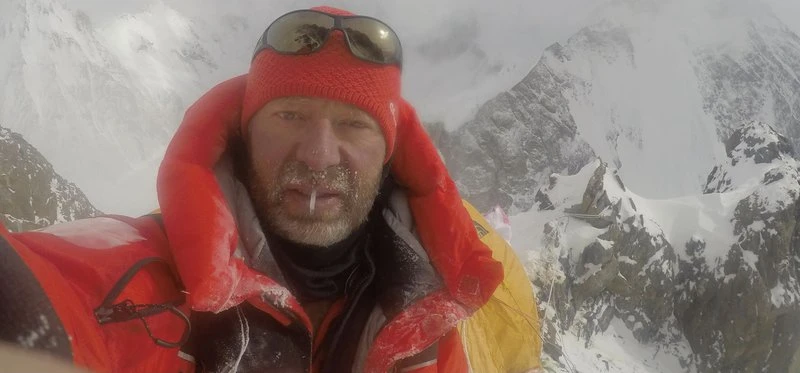
We spoke with an exceptionally perceptive thinker, doctor and mountaineer, dr. Tomaž Rotar. Not only did he recently attempt a winter ascent of K2, something no one had ever achieved before. Together with his family, he has travelled all over the world in search of mammals and different experiences of the kind that a deep, spontaneous ethnographic immersion in the reality of the unfamiliar invariably offers.
His encounters with the unimaginable depths of the chasms to which Tomaž so often brings his presence—when he does not fear life and therefore frequently comes face to face with death—have shaped him into a person who awakens in his interlocutor a desire for wonder. He speaks to that courage within us which ordinary life, with its conventional trials, silences. Dr. Rotar, an excellent dentist with his own practice in Radovljica, challenges us through his extraordinary insights to look within ourselves differently. Truly uncompromisingly. And he says that we should not avoid pain, but must instead teach it to “hurt us back.”
The excellent writer and mountaineer Nejc Zaplotnik once said: “Only from the summit can you see the next summit…” I have come to the same conclusion myself. Since I am a perfectly ordinary man from Gorenjska who surveys the horizons of the mountain range surrounding our beautiful home every clear morning, it is probably entirely logical that I have always wanted to see what lies beyond those sharp, magnificent lines separating the sky from the earth.
In my youth, the green Karawanks were also the boundary of a life in which coffee and bananas were scarce, let alone mountaineering equipment. They were also a symbolic boundary beyond which work and life were supposedly valued more highly. In those days, when my range, including my intellectual horizons, was limited to a few dozen kilometres from home, I never imagined that I would one day become one of the heroes from the adventure books already being written by our mountaineers. Yet life sometimes brings beautiful things; you need only believe and never abandon your dreams. We may merely put them away in some dusty little drawer of the heart, to be opened again when we have had enough of everything here at home.
I can therefore attribute my “unusualness” solely to the courageous spirit that allows me to lock the door of my home and spend two hours overcoming doubtful thoughts while waiting for “boarding.” Once the aircraft retracts its landing gear, everything begins to flow by itself. Thoughts detach themselves from the everyday walls that suffocate a life of desires—in other words, Life itself and the vitality of its moments. Problems become challenges, fears become strength and energy, and imagination becomes reality. That is when we begin to live, because we feel that we know what we are living for. Love is then no longer merely a word, but an invisible embrace that warms us when the cold sets in, comforts us when things are difficult and shows us the way when we are lost. The only impossible journey is the one that never begins; it is as simple as that.
I think we all have similar desires. I also think that most people, at some wild moment in their lives, consider how wonderful it would be to stand one day on the highest summit on the planet, perhaps cross a desert, fly in an aerobatic aircraft, see Antarctica or idyllic tropical islands, search for gorillas in a rainforest, sit in the middle of the African savannah, watch a volcano spewing lava and experience similar, yet entirely earthly, processes and adventures.
I also think that most people in our country have enough money to afford at least one of these “crazy” experiences once in their lives, yet it does not happen. People are simply afraid to leave the comfort of their everyday lives. Perhaps they expect things to happen by themselves, believe they will remain young and healthy forever and assume that the right moment to buy an airline ticket will certainly come eventually. But that moment never comes; we lose it forever unless we seize it while the idea is still warm, while we are still in love with it and while we are prepared to endure the difficulties and challenges of such journeys.
When they look back on their past, they simply do not dare admit that they missed those moments because of their own vanity, material greed or timidity, and they usually end such conversations with the self-consoling sigh, “Oh well, as long as nothing worse happens…” In our grandparents’ time, such “madness” was a privilege reserved for a select few and for kings, whereas today almost every European and American can afford it. It seems to me that it is almost our duty to make use of the privilege within our reach. Our ancestors longed for it. If we cannot make the effort for ourselves, let us at least do it for them.
Because the next summit can be seen only from the summit, I began with Roblek and Begunjščica; whenever I had access to transport, I travelled to the Alps. We discovered ski touring and could only dream of equipment that is entirely ordinary today. During secondary school, I cycled extensively, was a member of the junior national team and travelled to the European Alps for the first time. We journeyed across the whole of Europe in our “Katrca,” slept in car parks, and a medium-sized backpack was enough to survive for a month or more far from home. Mont Blanc seemed infinitely high to me, and Mattrehorn infinitely dangerous. I once even set out for Grossglockner by bicycle.
To my colleagues and me, the world around us seemed like a book of mysteries. We were explorers, poets and dreamers, and every goal we achieved gave rise to a new challenge. We invested every dinar we earned in equipment that, in dreamlike Cortina, was almost prohibitively expensive for us. We regretted nothing, were ashamed of nothing and failure never clipped our wings; it merely spread them wider, and every day we grew stronger. We never felt inferior because we had no money, nor did we ever ask God to solve our problems. We were omnipotent; we were young.
South America, Aconcagua and Patagonia were turning points in a way. For the first time, I travelled by plane to another continent; for the first time, I saw people who were so very different from us. We differed in skin colour, stature and language … But that was not all: we also differed in our understanding of life and happiness—that simple happiness which sometimes becomes alien and incomprehensible to us here at home today. That is why I sometimes have to leave home with nothing but a bag containing everything I truly need for life and nothing more. When things become “complicated,” I go in search of that happiness so that everything becomes simply clear to me once again.
The Himalayas came later, when I had also become financially strong enough to travel so far from home.
I have had this privilege three times. I have stood on three of the highest summits: Everest, K2 and Kangchenjunga. The Himalayas are not merely about mountaineering. They are the greatest adventure, perhaps the only one that brings us close to the kind of adventure that can otherwise be experienced only beyond our planet and which remains a privilege reserved for the truly wealthy.
Every journey is a challenge, and mountaineering in the Himalayas is probably the greatest challenge we can face. Every challenge partly fills us with fear of the unknown and of a potentially bad outcome. Yet all beautiful things are on the other side of fear. In the Himalayas, fear is usually justified, but it protects us from mistakes and death. Fear is the best safeguard, but we must administer it in precisely the right dose, like any medicine that protects us from disease. If there is too much of it, it fills us with panic; if there is too little, we cross the limits of our own abilities too quickly—and at an altitude where only jet aircraft operate normally, that means certain death.
Every one of us is afraid, and we are usually frightened by similar things, which is entirely understandable. Fear developed over thousands of years of evolution, and we are all descendants of people whom fear protected from death. People capable of climbing eight-thousanders have merely developed methods for controlling their own fear. But the fear remains.
Life, too, is a journey or a “safari,” as it is called in Swahili, the language of the Maasai. I would prefer to say that a life without journeys and challenges is not a real life. That may sound pompous and arrogant, but it is how I feel, and I am glad that I do. Travelling and exploring, particularly the useless world in the heart of the Himalayas where only a few venture, is what has given meaning to my existence. It fills me with the feeling that I am on the right path when anticipation keeps me awake because reality is more beautiful than dreams ...
Perhaps it is precisely victory over our own fear that provides the greatest satisfaction, enriches us the most and most effectively calms a restless spirit. We are most often our own greatest rivals and may even be our own enemies. Facing our own fears is the hardest thing of all, because we can all be teachers to others, but rarely to ourselves. When we overcome our own fear, we can make peace with ourselves. This insight is one of the noblest pearls I have gathered on the icy slopes of the highest mountains. The scars remain, like bright medals that shine more strongly when night once again catches us on a steep, icy path and the rope runs out.
K2 was the last of the eight-thousanders that had not yet been climbed during the meteorological winter. I reached the summit of the world’s second-highest mountain on 21 July 2019. We made our first winter attempt last winter and tried for a second time in the winter of 2020/21. Last year, I climbed with John Snorri, an Icelander who sadly remained on the mountain this year. We were also joined by the leading Russian mountaineer Denis Urbko, who was eventually buried by an avalanche on the slopes of the neighbouring Broad Peak. He retired from the sport after the accident.
This year’s expedition was considerably larger and featured renowned professional mountaineers from around the world. Many of us had already climbed K2 during the summer, but a winter ascent was unknown territory for everyone. Several expeditions had attempted the summit in winter conditions in the past. The Polish national expedition came closest to the summit, reaching an altitude similar to the one I attained this year. The Abruzzi route is regarded as the classic approach and is the route by which I reached the summit in summer. Some expeditions attempted to reach Camp III via the Česen route, named after our well-known mountaineer Tomo, who unfortunately did not reach the summit.
It would be difficult for me to speak about the commercial nature of expeditions, since I do not really understand the designation. “Commercial” is supposed to mean profit-making or money-making, which certainly does not apply to me or many others, because on every expedition to date we have spent a great deal of money rather than earned it. Some professional expedition participants may also earn some money, since sponsors cover their expedition costs and they themselves earn money through social media and perhaps advertising.
Even when members of the first Yugoslav expedition climbed K2 in 1996 under the leadership of Viki Grošelj (according to the records, I am supposedly the third Slovenian to have climbed K2), the expedition was organised very similarly to those of today. The difference was that there were considerably more porters, although it is true that the mountain did not have as many remnants of ropes, which provide substantial assistance to every new expedition.
Today, it is impossible to climb Pakistan’s highest peaks without permits, which are invariably obtained by local mountaineering agencies that usually also manage the logistics of reaching base camp. Operations at base camp are most often managed by Nepalese agencies, naturally through local agencies, which also arrange the Sherpas and equipment that assist mountaineers on the mountain. According to one definition, an ascent is commercial if, in addition to services at base camp, mountaineers use the assistance of Sherpas on the mountain. This includes ropes—some left by previous expeditions and some replaced during each expedition—and tents that Sherpas from the Nepalese agency may carry onto the mountain.
I have witnessed many “non-commercial” ascents in which mountaineers used the same ropes as commercial climbers and slept in the same tents when they happened to be available, yet after returning to the valley they described their ascent as non-commercial because they had paid only for base-camp services. It was similar last winter, when Snorri and I carried and fixed the ropes ourselves, but our ascent was still considered commercial. I think that a new term will gradually have to be introduced, or we should simply forget the distinction between ascents. Ultimately, those differences no longer exist unless the ascent follows a new route or is undertaken in alpine style, where old ropes cannot be used or the mountaineers deliberately choose not to use them.
That is correct; this year’s winter expedition was the largest to date. John Snorri and Ali Sakbara, a Pakistani mountaineering star, had already been at base camp for almost a month before the main group arrived. A week before my group, a team of professional Nepalese Sherpas led by Nims also reached base camp. Some time ago, he established a new milestone in high-altitude mountaineering by climbing all fourteen eight-thousanders in a single season.
Compared with last season, the weather was very good. This year, the journey to base camp took us only five days, compared with eleven last year. On the second day, we began our acclimatisation ascents or rotations, the purpose of which is to allow the body to adapt gradually to living under lower oxygen pressure. During the second rotation, Spain’s leading mountaineer Sergio Mignote suffered a fatal accident. He fell almost one thousand vertical metres and came to rest at the foot of the mountain. We carried his shattered body to base camp, where it was collected by a military helicopter. The Nepalese made excellent use of the first extended weather window and became the first in history to reach the summit in winter. They were received by the president of Pakistan and welcomed like kings in Nepal.
Our team attempted the summit during the second weather window, which was one day shorter, while the wind was somewhat less merciful than during the first window. Together with the Sherpa Timbo, I reached an altitude of eight thousand metres, where a large crevasse halted our progress even though we had followed the established route along which ropes had been fixed. Apart from John Snorri, Ali Sakbara and the leading Chilean mountaineer Pablo, Timbo and I were the only ones to reach this altitude. Unfortunately, only Timbo and I returned to the valley. The last time I saw the three of them was beside the large crevasse, and their fate remains unknown to this day.
The Bulgarian mountaineer Atanas, who had already climbed eleven eight-thousanders, also died during the descent. The expedition was therefore marked by the success of the Nepalese Sherpas, yet I somehow cannot rid myself of the doubts that still trouble me and some of my colleagues.
I still feel uneasy, even though I returned at the end of February this year. During the final ascent, the Nepalese wanted to be alone. After one of the Sherpas told Snorri that they were not yet heading towards the summit, he turned back towards base camp. It is still not entirely clear where they crossed the crevasse, and the information that slowly emerged long after the summit had been reached varied considerably.
None of the members carried a GPS device, which, as it did for all the other mountaineers on the expedition, would have enabled a precise analysis of their route and also proved that they had genuinely reached the summit. The latter fact in particular is almost absurd, as they knew they were heading towards a historic moment and that, as professionals, they had to document their ascent in some way. Photographs do exist, but they could be the subject of an extensive debate.
The expedition will forever bear the dark mark of five deaths, including those of Ali Sakbara, with whom I stood on the summit of K2; Atanas, with whom I shared the summit of Kangchenjunga; and John Snorri, who had become like a brother to me during last year’s winter expedition.
The fate of the three will probably always remain a mystery. Their bodies may be found by members of a future summer expedition if exhaustion was the cause of death. If they fell into a crevasse or died as a result of a fall, their bodies will probably never be found. Snorri’s widow Lina invited me to join a summer expedition whose purpose was supposed to be to locate the bodies and also determine the presence or absence of ropes through the “Bottleneck.” Ali’s son Sajid, who accompanied his father to the entrance of the difficult section, claims that there were no ropes there. If this is true, doubts about the Sherpas’ ascent will intensify.
In winter, the Karakoram is probably the most inhospitable environment on the planet, particularly K2. Even at base camp, temperatures rarely rise to - 10 degrees below zero and average around twenty-five degrees below freezing. Temperatures fall dramatically with altitude. I measured fifty-five degrees below zero on the night when I was ascending towards the summit. The effect of the cold is greatly intensified by powerful winds that can reach two hundred kilometres per hour on the slopes, conditions that no living organism can withstand. The mountain is notorious for its high fatality rate, which stands at 25 percent for summer ascents. In winter, the boundary between life and death is far thinner still, as this year’s expedition also demonstrated.
John Snorri was a father of six, a husband, friend, ally and a man who, one year ago, twice saved me from the fate he ultimately suffered himself. We said a brief farewell on an icy, star-filled night in the death zone, promising that we would see each other again someday. Even to people who do not believe in life after death, among whom I count myself, it seems almost inconceivable that this will not happen.
A bond—unseen yet stronger than every doubt about promises—was formed on slopes guarded by gods, perhaps different from those we know at home, but powerful enough to bridge the infinite distances between our worlds. John is probably happy. He remained where the day is longer, closer to the stars than anyone else, where there is room for rest without end. There, where our world ends and the world of demons, unfinished stories, desires and gazes forever fixed upward towards the summit begins.
“Every lesson has its price” is the first of my grandmother’s many sayings that I remember. She survived both world wars, hunger and suffering that we can no longer even imagine today. The definition of travel is learning—in other words, adapting to living conditions that constantly change along the way. It would be difficult to compare it with reading a book, which we can close at any moment and replace with another if it no longer appeals to us. A journey is not about the destination; the journey is the essence in itself, just as life is intended to be lived rather than merely to carry us towards death. Travel is learning through first-hand experience, and scars are therefore part of every journey, just as they are part of every life. Good decisions come from experience, and experience is most often the result of bad decisions.
Mountaineering is also a journey that sometimes leads to the summit; when it does not, we merely have a good excuse to set out once again. Mountaineering represents a constant challenge to death with the objective of remaining alive. This may be a senseless paradox, but it also means that there are no defeats as long as you remain alive. After death, everything is supposedly meant to begin again. And yes. Fear of death is therefore merely a consequence of fear of life.
The pain we experience on difficult and steep routes is the finest tool for shaping one’s personality, which is why we must not forget, suppress or ignore it. We must allow it to do its work. Consolation during difficult moments merely wastes the most valuable teaching instrument—one that will, in any case, always pass. It is up to us how we use a period of pain. We may allow ourselves to be broken. We may turn back along the way, or we may persevere and allow ourselves to mature. In this way, we become stronger and learn how to “hurt pain back.” We learn to accept it as a teaching tool and cease fighting against it. We fail only when we stop trying, because life will always find a way to bring us to our knees.
I think a person should always harbour a little doubt about information received from the surrounding world and should ask whether the actions of other people and their own actions are truly aligned in the right direction. Could the book you have read really be true? Did the mountaineers genuinely reach the summit? Is the treatment truly correct? Does God really exist, and why do so many people on this planet blindly believe in anything—not only in a God whom they have never seen, heard or felt …
Believing in something you have never seen, never questioning what you actually believe and never making an effort to find the answer … That is probably called faith. Belief is therefore a state in which the desire to explore and seek answers to the key questions in our lives is absent, and it is entirely clear why it has become so deeply rooted in our species. Faith provides answers without evidence to questions whose answers would otherwise be difficult to find. Faith blames fate for one’s own failure, which is the easiest option. Faith transfers responsibility for illness to God, or to something over which we ourselves have no control.
Belief appears to reduce the sense of fear about forthcoming events, even though we entrust the future to someone we have never seen. Faith is life’s analgesic: it merely reduces pain, doubts and fears, but does not cure the disease or answer the questions that some of us ask. Analgesics, or pain-relieving medicines, are the most sought-after medicines on the planet. For a similar reason, belief is the most common brain activity among the animal species called human beings, who claim that it is the principal quality separating us from animals.
The exploratory spirit does not make life easier and represents the opposite of belief, or of trusting in something that no one has yet seen, proven or felt. Exploration is the complete opposite of the intellectual comfort offered by faith. Explorers of every kind are always in the minority and are usually pushed aside by herds of people who seek refuge in the same “indisputable” convictions. Perhaps their lives are easier, since they do not have to ask questions.
The Middle Ages provide cruel evidence of the extraordinary herd instinct among people, which fortunately not everyone possesses. Those solitary individuals in the distant past, when herds offered a greater likelihood of survival, probably would not have survived. Similarly, only a few explorers survived the Middle Ages, since almost all of them were burned at the stake. History also shows that only a handful succeeded in creating the considerably better present we enjoy today, one founded on exploration, science and evidence.
The most important day in life is the day we are born, while the second most important is probably the day we discover why we were born. It is our duty to try to find that answer, because only then can we make peace with ourselves. It is therefore our duty constantly to ask ourselves what we can achieve, how far we can travel, how steep a path we can master, how beautiful a girl we can invite for a drink, how many people we can help and perhaps, ultimately, whether death truly is the end of everything.
Eight-thousanders demand everything a person can extract from themselves, both physically and psychologically. The exhaustion at the end of an expedition usually obscures the satisfaction and pride of success, while the pain of unhealed wounds likewise prevents us from comprehending a possible failure. I do not think anyone who has returned from a summit could immediately go back up the mountain. Everyone wants to go home, somewhere warm, drink a cold beer, enjoy a hot shower and see their loved ones and their home again.
Human memory, however, is selective. We soon forget the bad and difficult things and remember only beautiful images and the sharp white horizons of the world’s most magnificent mountains. We remember warm conversations in communal tents, broad Nepalese smiles and infinitely happy barefoot children hiding from the expensive lenses of Sahabs, or white foreigners. We remember friends, and we remember the bonds that connected us. Once again, we fall for the lies or partial truths of our own memory and return to the same story with the same expectations and desires. If we remembered everything, our mountaineering equipment would remain forever covered in dust in the darkest corners of our cellars.
When the brain is gasping for a basic necessity, we are no longer who we usually are. The primary task of the most important organ in our body is awareness of our own existence—in other words, orientation in time and space. If the brain cannot perform its task adequately, awareness may become incorrect, distorted, unrealistic and dangerous to the body it controls. Memories of the mountain are full of gaps; it may even happen that we cannot remember standing on the summit. Experience teaches us that the problems we see before us are merely the consequence of incorrect thinking, nothing more than an unfounded illusion, and may not be problems at all—or, as some say, “they exist only in the eye of the beholder.”
Experience also confronts us with the crucial question of existence: “Do we even exist, and are we what we think we are?” The experiences are probably similar to those that occur when taking hallucinogenic substances, when drug users experience things differently from us, see things others do not, perceive events around them differently from others and therefore respond to them differently as well. I do not perceive such experiences as otherworldly or in any way connected with Gods. We describe them that way when we want to make events more accessible to readers or make ourselves seem more important. The experiences are fascinating, while exploring what happens inside our bodies is infinitely compelling, almost irresistible.
In conditions where there is three times less oxygen than at sea level, life is different—not only in reality, but primarily because we see it differently. The brain needs only two things to function: glucose and oxygen. If oxygen is lacking, it functions differently or ceases to function altogether. We therefore call altitudes above eight thousand metres the death zone, where life without supplementary oxygen compressed in cylinders does not exist, or is possible only for a very short time.
Limiting life to a few hours places our perception of it on a different level. We realise that death is life’s greatest invention. If we allow it close enough, it whispers truths that perhaps all of us know to some extent, but simply refuse to acknowledge. What happened yesterday is merely the past. All that remains is a beautiful memory, and without it, the time would have been lost. Tomorrow is merely a mystery, which is why our dreams must be so immense that they frighten us. Only then will we know that they are large enough. Dreams alone illuminate the path from birth to death. Today is God’s gift, so let us shine like the sun—but we must understand that, in doing so, we must also burn out like the sun.
In life, we usually know which path is the right one, but it simply seems too difficult to choose. We must live for something beyond ourselves, something greater than ourselves. We must live with passion, regardless of the consequences. If we cannot do great things, let us do small things magnificently. Life is entirely simple and has only one characteristic: it moves forward. Let us therefore always face the sun, and we will never see the shadows.
Published: 18 April 2021, 17:27 | Written by: Izr. prof. dr. Lucija Mulej