


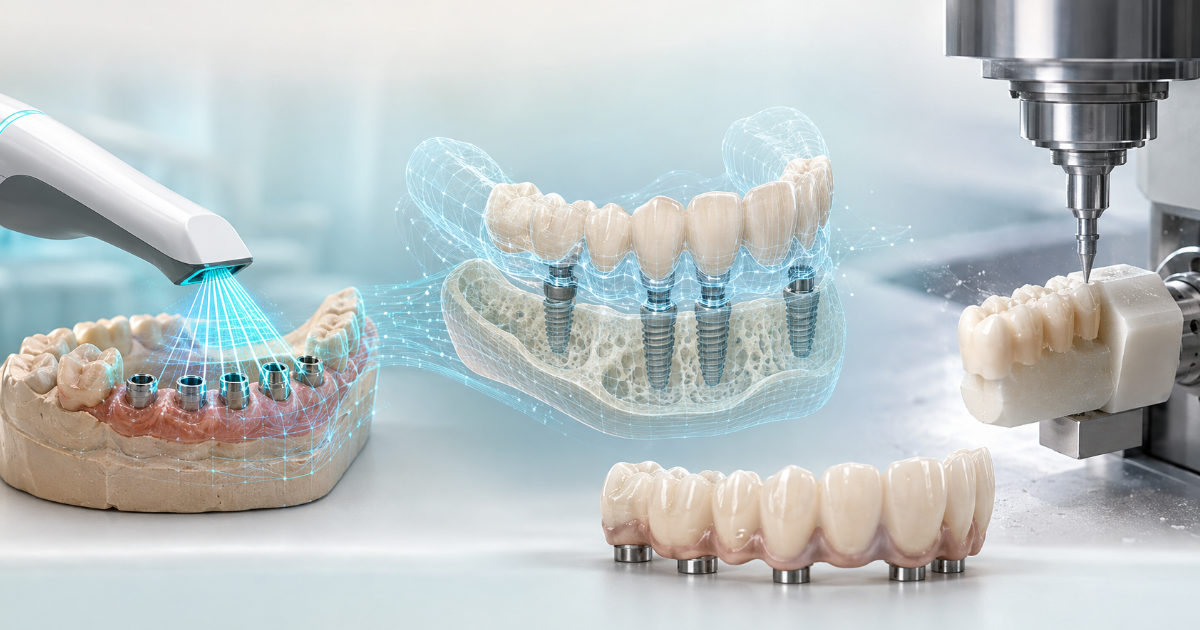
Patients expect the highest level that can be achieved in prosthetic dentistry from prosthetic rehabilitation on dental implants. The reasons are, of course, the high cost, which is already fundamentally determined by the use of dental implants, and the relatively lengthy and demanding procedure, which patients experience personally. The result must therefore correspond to the investment, regardless of the problems the clinician encounters on the way to the goal. With digital support, the surgeon, prosthodontist and dental technician can work as a team to achieve satisfactory results. CAD/CAM technology has thus become a mainstay of surgical and prosthetic support.
When deciding on the mode of treatment, several factors are decisive: the patient’s oral health, wishes, financial capacity and ability to cooperate during treatment. Backward planning is indispensable, because it makes it possible at the very beginning of treatment to determine whether the parameters influencing implantation are sufficient or insufficient for the final fabrication of the prosthetic restoration.
The digital processing chain has primary components: a scanner (including an intraoral scanner) for digital data acquisition, software for processing the data, and the corresponding hardware. In the narrower sense, the technology means the fabrication of prosthetic restorations (in this case on implants), temporary or definitive, by milling prefabricated blocks of different materials: zirconium oxide, aluminium oxide, infiltrated ceramics, glass ceramics, titanium, noble and non-noble metals, acrylic resin and wax. Because of the “cold” method of material processing, the technology has certain advantages over conventional material processing: consistent quality, materials without internal stresses, and reproducibility of the product because all fabrication data are stored in digital form. With the method described, it is extremely important that all fabrication components are well coordinated with one another. Despite digitalisation and simplification of procedures, the precision and quality of the product still depend on the experience and professional knowledge of the dental technician and dentist.
The scanner is the entry point for digitising data and fabricating the prosthetic restoration. It is used to record the initial or intermediate conditions. The initial condition may be the situation in the mouth (intraoral scanner), a conventionally taken impression, or an analogue model cast from it. Software can then be used to design temporary crowns, temporary bridges, definitive crowns, bridges, primary and secondary structures, and tertiary components for removable restorations. Various software tools are available for positioning and processing margins and contact points, designing the occlusal surface, determining the relationship with antagonists and designing virtual articulation.
Individually designed abutments in the transmucosal sector enable an optimal framework design and, in aesthetically sensitive areas, an optimal course of the gingival margin. When fabricating single crowns, an optimal retentive form can be achieved, while the preparation margin can be designed individually so that residual cement can be removed easily and completely.
Temporary fixed implant-supported constructions are particularly important in more complex rehabilitations. The temporary restoration itself provides relatively good rehabilitation, which is essential because of the prolonged period of osseointegration, especially in the upper jaw. At the same time, it provides the clinician with all the information needed for the definitive construction. Vertical dimension, occlusion, phonetics, hygiene and aesthetics are parameters that can be changed during function on the temporary restoration and adapted to the patient’s individual wishes and, of course, to accepted clinical requirements. A temporary restoration that meets all requirements can be scanned before fabrication of the definitive restoration, and the definitive restoration can then be generated from the acquired data. Fixed constructions can be retained with cement or screws.
Because of precise digital procedures, bars can be fabricated without stresses in the materials, allowing the use of materials with high hardness and strength: titanium, zirconium dioxide… Bar designs can vary greatly and can be freely selected by the clinician and technician. Secondary constructions on bars can likewise be fabricated with CAD/CAM technology. Working models, gingival masks and tooth-set-up plans are helpful; their characteristics are used in preparing the digital model.
A major advantage of fabricating constructions with CAD/CAM compared with conventional fabrication is that errors occurring with conventional rehabilitation can be deliberately avoided or at least reduced. This is enabled by pre-fabrication of a virtual situation that alerts us to these errors in advance, while the system itself can also correct them. A prerequisite for correct and effective functioning of the system, and therefore for making full use of the high technology it offers, is consistent and good communication between the dental technician and the clinician.


