


Planet Siol reported today that, according to the business portal bizi.si, the 25 largest companies engaged in dental activities generated around 14 million euros in revenue last year.
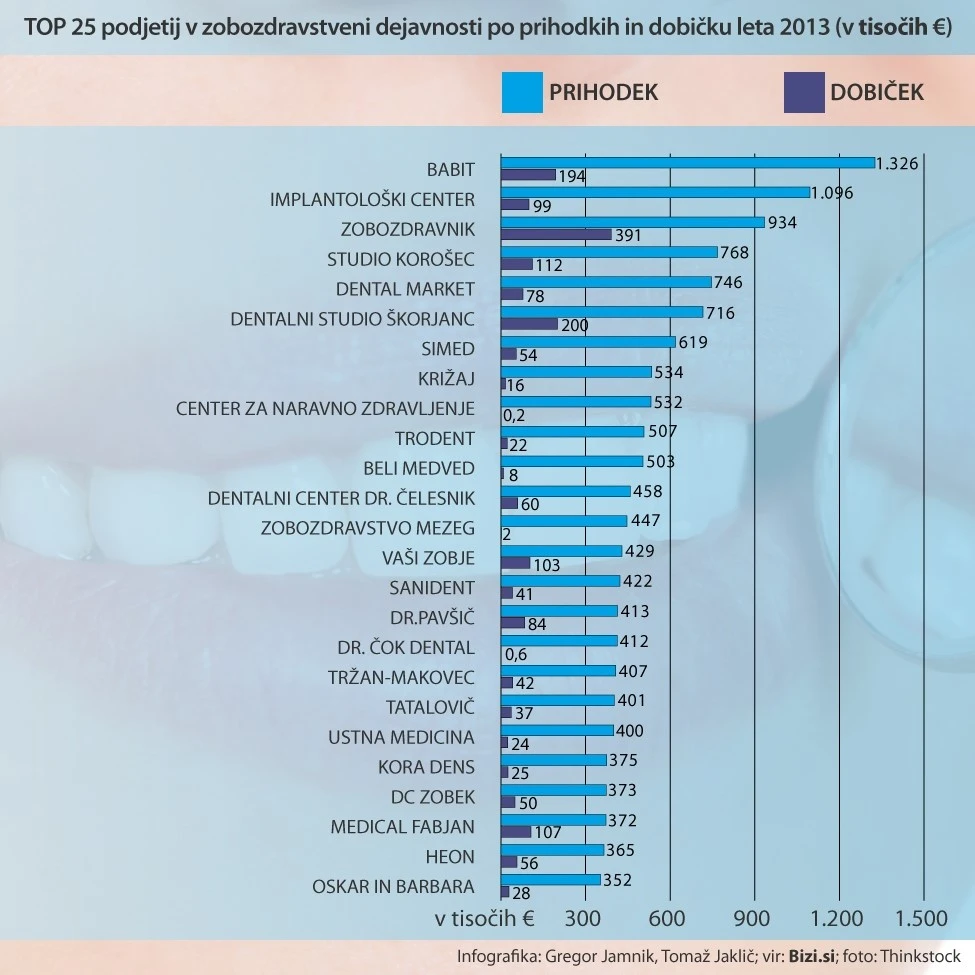
Dentistry is one of the most profitable activities in medicine in Slovenia. Last year, the 25 most profitable private providers generated around 14 million euros in revenue. According to the business portal bizi.si, last year's revenues of the 25 largest companies in dental activities did not change significantly compared with 2012, while together they generated almost two million euros in profit.
With 12 employees to 700 thousand euros in profit
The top three companies by turnover (Babit, Implantološki center and Zobozdravnik) recorded more than three million euros in turnover and generated just under 700 thousand euros in profit. Together, the three private providers mentioned employed an average of only 12 people last year.
The number of dentists increases every year
Last year, 56 providers of dental and other dental services were established, and 31 so far this year, most of them (15) in Ljubljana, four in the Podravska region, three each in the Savinjska region and the Goriška region, while one or two new practices opened in other regions. Compared with last year's figures, the number of private providers who decided to enter dental activity this year is 20 percent higher.
Before the year 2000, 352 dental practices were established in Slovenia, which means more than one third of the dental providers currently active.
Before the year 2000, 352 dental practices were established in Slovenia, which means more than one third of the dental providers currently active.
Konrad Kuštrin, president of the Fides trade union, on dentists:
How can we explain the fact that there are more dentists every year?
"This shows that dentists do not feel comfortable in the public sector. These are also tendencies among many other professional groups, for example family doctors. One reason for private practice is that in this way they can manage their working time more easily. They are also bothered by the large amount of administration in health centres; they feel that it consumes healthcare funds and thus their earnings. Therefore, it seems more economical to them to reap the results of their work themselves. That is the only logical explanation."
So is the state taking poor care of the dental sector?
"Compared with the EU average, Slovenia has enough dentists. Although many young dentists graduate today, many do not want to work at the primary level because they feel it is a demanding profession. Young people are concerned that they would have too many patients and would not be able to examine them thoroughly, and that they might therefore make a mistake that could harm a patient.
That is why these matters will urgently need to be regulated. Standards for doctors' work will have to be adopted so that it is clear what a dentist at the primary, secondary and tertiary level must do in order to receive a salary, and what an employer cannot force them to do. Too much work in medicine is not safe. Financing is another story, but that falls under the responsibility of the state."
What do you expect in the future? Will the trend of new dentists continue to rise?
"I think the trend will stabilise, because there are currently enough dentists. We are reaching the EU average, unless those who are now employed in public healthcare move toward purely private practice or concession-based practice."
Only nine private providers at independence
Understandably, Slovenia recorded a high percentage increase in providers of dental services in the years after independence, when the country transitioned to a market economy. Thus, in 1989 one dentist had a registered dental activity, in 1990 there were five, and in the year of independence there were nine.
The largest numbers of new oral-medicine service providers entered the market in 1995 (60) and 2008 (69).
Most dentists are in the Central Slovenia region
As expected, the largest region, Central Slovenia, has the most dentists, 326; 138 work in the Podravska region, followed by the Savinjska region. The fewest dentists work in the Lower Sava and Zasavska regions: 21 in the former and 11 in the latter.
Among dentists and dental-medicine workers, the most popular organisational form is registered healthcare professional, chosen by more than half of the entities (495), followed by limited liability companies (326), sole proprietors (101) and institutes (43). One dentist or dental-medicine worker each chose the organisational form of an unlimited-liability company, public institute, limited partnership and cooperative.
Compulsory settlements and bankruptcies are rare among dentists. In the last three years, including this year, there have been no such proceedings among registered dentists. There were, however, three liquidations during this period.
Author:
Uroš Kokošar
Source: Siol